AI, Ethics & Originality
- Mar 14
- 3 min read
⸻
Introduction
Artificial intelligence has made it easier than ever to design tattoos.
You type a few words into an AI generator, hit “enter,” and suddenly you’ve got a unique, stunning piece of art staring back at you.
But here’s the big question nobody seems to ask:
Who actually owns that design?
As tattoo artists and clients start using AI for inspiration, the lines between originality, authorship, and ethics are getting blurry.
Let’s untangle it — and see why, even in the age of algorithms, creativity still belongs to people.
⸻
Table of Contents

1. What Makes an AI Tattoo “Original”?
AI tools like Midjourney or DALL·E don’t create from thin air — they learn by analysing millions of existing artworks.
So when you generate an image, it’s not completely new. It’s a remix — fragments of styles, textures, and ideas pulled from human work.
That means no single person (or machine) can truly claim it’s original.
The originality comes when a human reinterprets it, adapts it, and brings it into the physical world through tattooing.
⸻
2. Can You Copyright an AI Tattoo Design?
In the UK and most countries, copyright law only protects human-made creations.
AI can’t legally hold ownership, and if an image is generated purely by AI, nobody owns exclusive rights to it.
So if you bring an AI design to your artist, it’s usually considered “open source” — meaning anyone could technically use it.
That’s why it’s so important to customise AI designs before tattooing.
Once an artist interprets it and modifies it by hand, that version becomes theirs — a unique work of art protected by human creativity.
⸻
3. The Artist’s Role in Giving It Life
AI provides a spark.
The artist provides life.
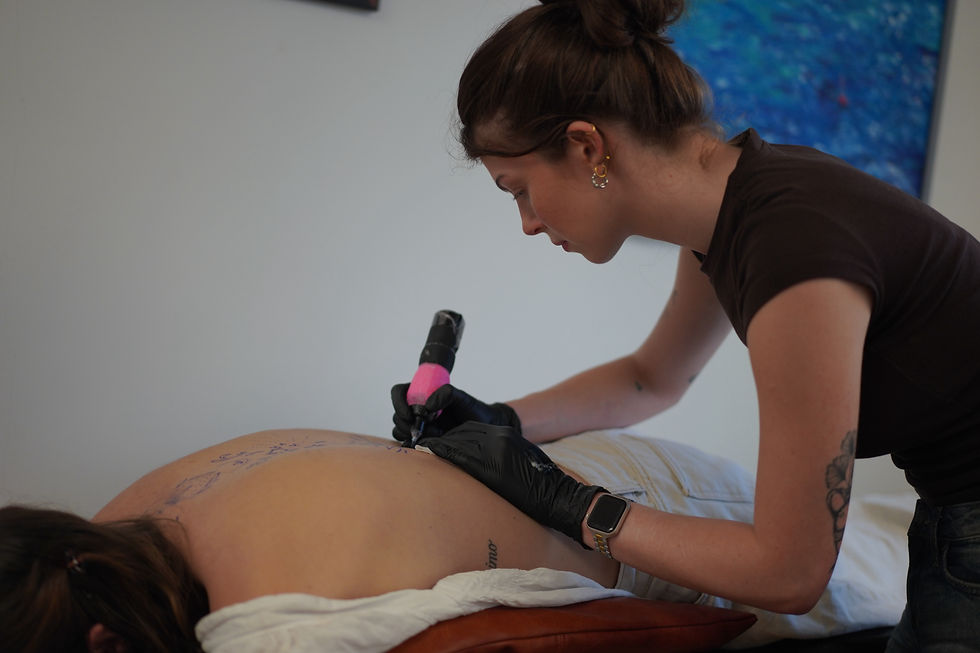
A tattooist doesn’t just trace an AI image — they redesign it to fit your anatomy, adjust the composition, and ensure it works safely on skin.
That transformation process is what turns data into design — and gives it a soul.
At our tattoo shop, we see AI as a collaborative tool. You bring the inspiration; we bring the craft. Together, we make something truly yours.
⸻
4. Why Human Collaboration Creates True Ownership
Ownership isn’t about who typed the prompt — it’s about who made the creative decisions that turned it into something meaningful.
When a tattoo is designed, adapted, and inked by a human artist, the ownership shifts to the creator and the wearer.
You own the story behind it; the artist owns the technique.
That shared authorship is what makes tattooing such a personal and powerful form of art.
⸻
5. The Ethical Side of Using AI in Tattooing
AI raises an important ethical question: how do we ensure respect for the artists whose work trained these models?
The answer is intention.
When we use AI responsibly — as a brainstorming tool, not a replacement — we honour both past artists and our clients’ individuality.
The goal isn’t to copy; it’s to evolve.
That’s how AI becomes a bridge between inspiration and originality — not a shortcut that cheapens the art.
⸻
Conclusion
AI has blurred the line between inspiration and creation — but not between right and wrong.
Ownership, in the world of tattooing, still belongs to the people who create, feel, and transform ideas into lasting art.
So if you use AI for tattoo ideas, use it wisely.
Make it your starting point — not your signature.
Because no matter how advanced the technology gets, the human touch will always be the final author.
⸻
FAQs
Q: Can I copyright my AI-generated tattoo design?
A: Not if it’s made entirely by AI. Only designs with clear human modification can be protected.
Q: Is it okay to bring an AI tattoo design to an artist?
A: Absolutely — just be open to adjustments so it becomes uniquely yours and safe for tattooing.
Q: Do tattoo artists own AI-inspired designs they create?
A: Yes. Once they modify, adapt, and execute the design, it becomes an original human artwork.