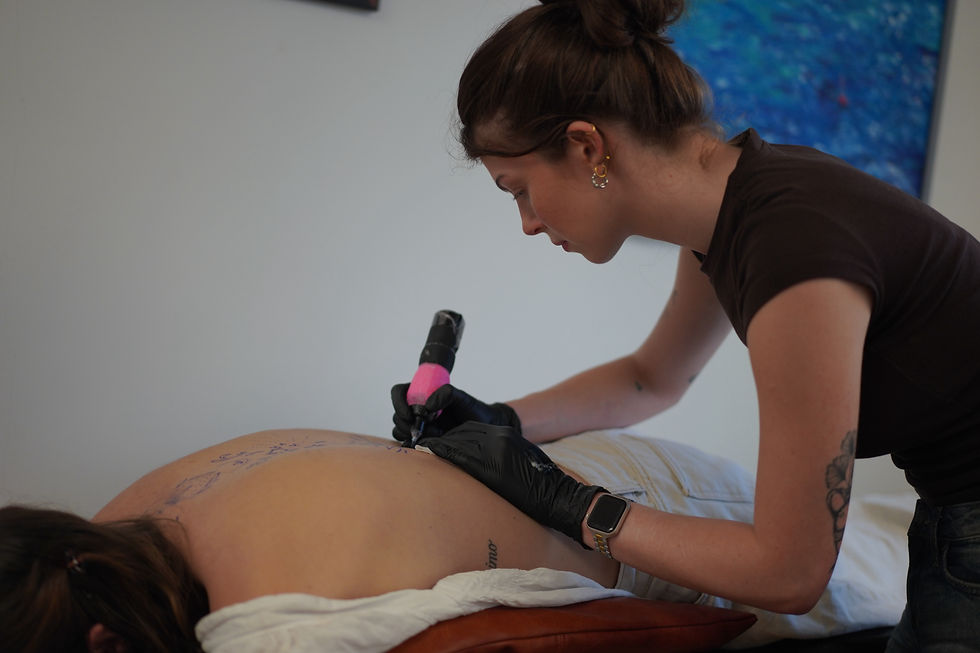
From Prompt to Skin
⸻
Introduction
AI has changed how we imagine tattoos. You can now type a few words into a generator and instantly see detailed, futuristic artwork that would’ve taken hours to sketch.
But here’s the truth most people miss: those stunning AI designs can’t be tattooed as they are.
The colours are too bright, the lines too fine, the contrast too unreal.
What turns a good AI idea into a great tattoo isn’t technology — it’s translation.
Here’s how real tattoo artists turn your AI prompts into ink that lives beautifully on skin.
⸻
Table of Contents
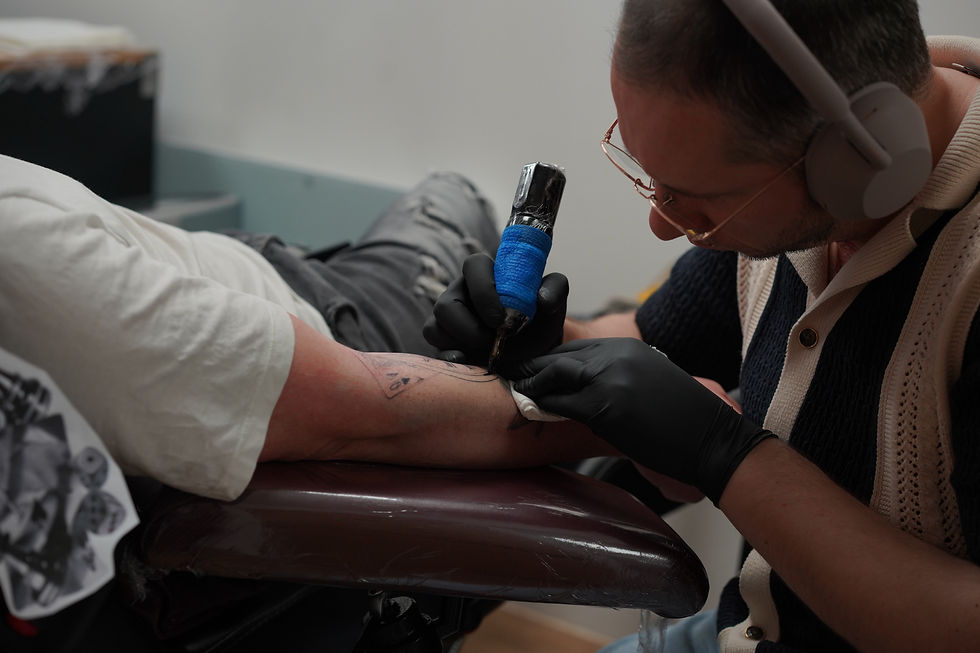
1. The AI Design Process — From Words to Image
AI tattoo generators such as Midjourney, Leonardo and TattooAI work through text prompts. You might type “black and grey lion with geometric patterns,” and within seconds, you’ve got several dramatic compositions.
For clients, it’s exciting — it makes it easy to explain what you want.
For artists, it’s a helpful reference, not a finished blueprint.
⸻
2. Why AI Tattoos Look “Too Perfect”
AI understands images, not anatomy. It exaggerates contrast, adds impossible shadows, and blends colours that pigment simply can’t hold in the skin.
On a screen, that wolf portrait glows.
On your forearm, it needs balance, spacing and readability so it still looks great 10 years from now.
⸻
3. Translating Digital Design to Human Skin
When an artist takes your AI idea, they adjust everything:
• Simplify tiny details that would blur once healed.
• Boost contrast so shading stays bold long-term.
• Adapt placement and flow to match muscle movement.
• Ensure ink density suits your skin tone.
It’s a re-engineering process — the difference between digital perfection and living perfection.
⸻
4. The Artist’s Eye: Flow, Anatomy & Longevity
A skilled tattooist sees beyond the flat image. They consider how the design follows the body’s rhythm, how shapes complement natural curves, and how the piece will age.
That’s something AI can’t yet feel — because tattooing is tactile. The warmth of skin, the stretch, the way blood rises — all influence the outcome.
⸻
5. Final Touches Before the Needle
Once the AI-inspired design is refined, the artist transfers it to stencil, checks scale, and makes final tweaks directly on your body.
This is where collaboration happens — a mix of your idea, AI inspiration, and your artist’s skill.
When it’s done right, you walk out with a tattoo that was born in AI but lives because of human craft.
⸻
Conclusion
AI has opened new creative doors, but real artistry begins when the machine stops.
Turning a digital dream into a real tattoo takes empathy, anatomy, and years of practice — the kind of knowledge no algorithm can replicate.
So bring your AI ideas — the bolder, the better.
Then trust your artist to transform them from pixels to pigment, perfectly made for you.
⸻
FAQs
Q: Can I get an exact copy of an AI tattoo?
A: Not safely. Your artist will adapt it to ensure it’s realistic, balanced, and long-lasting.
Q: Why does my AI design look different once tattooed?
A: Because skin absorbs pigment differently than a digital screen displays light.
Q: What’s the best way to use AI when planning a tattoo?
A: Use it for inspiration — themes, moods, or references — then collaborate with your artist to make it truly tattooable.